
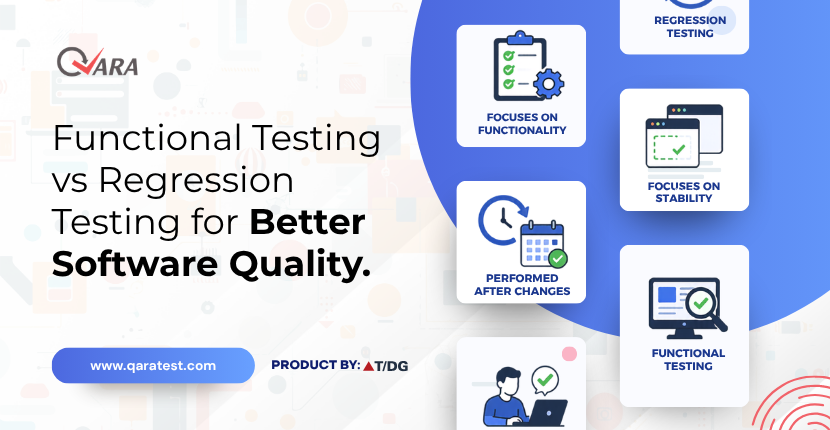
Functional Testing vs Regression Testing - How They Improve Software Quality
Functional Testing vs Regression Testing: Which Testing Approach Supports Better Software Quality?
Delivering reliable software requires more than identifying defects, it requires selecting the right testing approach at the right stage of the software development lifecycle. Among the most widely used quality assurance practices, Functional Testing and regression testing play distinct yet complementary roles in ensuring software performs as expected. While both contribute to application quality, understanding their purpose, scope, and use cases is essential for building an effective testing strategy.
These testing challenges can be effectively addressed through QARA Test, a comprehensive test execution management platform designed to simplify software testing across the entire testing lifecycle. With capabilities such as centralized test management, test execution, defect tracking, reporting, and integration with leading development and automation tools, QARA Test helps organizations improve testing efficiency, strengthen quality assurance processes, and support faster software releases. This guide compares functional testing and regression testing to help organizations understand their differences and determine when each approach should be used to deliver high-quality software.
How Do Functional Testing and Regression Testing Differ?
Although both testing approaches contribute to software quality, they serve different objectives within the software development lifecycle. Functional testing verifies whether new or existing features work according to defined business and functional requirements. It focuses on validating user workflows, application behaviour, and expected outputs before software is released.
In contrast, regression testing is performed after application changes such as bug fixes, enhancements, or updates to ensure that previously working functionality continues to perform correctly. As applications evolve, regression testing helps identify unintended issues introduced by new code changes, reducing the risk of defects reaching production.
Depending on project requirements, both approaches can be executed through manual testing or automated testing. Manual testing is valuable for validating new features, exploratory scenarios, and user experience, while regression testing is often automated to execute repetitive test cases efficiently across multiple releases. As part of a comprehensive QA testing strategy, combining functional and regression testing enables organizations to validate new functionality while maintaining the stability and reliability of existing applications.
How Do Test Cases and Test Execution Differ Across Both Approaches?
The effectiveness of both functional and regression testing depends on well-designed test cases and a structured test execution process. In functional testing, test cases are created to verify whether individual features, user workflows, and business requirements function as expected. Each test case focuses on validating a specific functionality and confirming that the application delivers the expected results.
For regression testing, test execution is typically centred on previously validated test cases that are re-executed after application changes, updates, or bug fixes. This helps ensure that existing functionality continues to work correctly without introducing new defects. As part of a comprehensive software QA strategy, maintaining reusable test cases and an organized test execution process enables teams to improve testing consistency, increase coverage, and deliver reliable software across every release.
Functional Testing vs Regression Testing Explained
Understanding functional testing vs regression testing begins with recognizing that these approaches are not alternatives, they are complementary testing practices that serve different purposes. Functional testing validates whether newly developed features and business requirements work as intended, while regression testing verifies that existing functionality remains unaffected after code changes, updates, or defect fixes. Together, they help maintain both feature quality and application stability throughout the software development lifecycle.
The choice between the two depends on the stage of development and the testing objective. Functional testing is typically performed when introducing or validating new functionality, whereas regression testing becomes essential whenever modifications are made to an existing application. With QARA Test, organizations can efficiently manage both testing approaches through centralized test planning, structured execution, reusable test assets, and detailed reporting, enabling QA teams to improve software quality while supporting faster and more reliable releases.
Choosing the Right Testing Strategy for Reliable Software Delivery
Both functional testing and regression testing are essential for delivering reliable, high-quality software, but they address different aspects of the testing lifecycle. Functional testing ensures that new features and business requirements work as expected, while regression testing safeguards existing functionality whenever changes are introduced. Using these approaches together enables organizations to reduce defects, improve application stability, and maintain consistent software quality across every release.
With QARA Test, organizations can effectively plan, execute, and manage both functional and regression testing through a centralized test execution management platform. From organizing test cases and tracking execution to generating detailed reports and integrating with development and automation tools, QARA Test helps QA teams improve testing efficiency, strengthen quality assurance, and accelerate software delivery.
Ready to optimize your software testing process? Contact us today to discover how QARA Test can help your organization simplify test execution, improve software quality, and deliver reliable applications with confidence.
In our next blog, we'll explore mobile app testing and discuss why it plays a critical role in delivering seamless user experiences across devices, operating systems, and network environments, while helping organizations ensure application quality, performance, and reliability.
Key Questions About Functional and Regression Testing
What Is the Difference Between Functional Testing and Regression Testing? Functional testing verifies whether an application's features work according to business and functional requirements. Regression Testing ensures that existing functionality continues to work correctly after code changes, updates, or bug fixes.
When Should Functional Testing Be Performed? Functional testing should be performed whenever new features, enhancements, or business requirements are developed. It helps verify that the application behaves as expected before being released to users.
Why Is Regression Testing Important? Regression testing helps identify unintended defects that may be introduced after software modifications. It ensures that previously tested functionality remains stable, reducing the risk of issues reaching production.
Can Functional Testing and Regression Testing Be Automated? Yes, absolutely. Both functional testing and regression testing can be automated. While functional testing may include both manual and automated approaches, regression testing is commonly automated to execute repetitive test cases efficiently across multiple releases.
How Does QARA Test Support Functional and Regression Testing? QARA Test provides centralized test management, structured test execution, defect tracking, reporting, and integration with automation tools. This enables QA teams to manage functional and regression testing efficiently while improving software quality and accelerating release cycles.